 digitizemypattern
How to trace a sewing pattern
Tracing a sewing pattern means copying the shape of a piece onto something else, so the original is never cut or pinned through. Three methods do it: a sheet you can see through and a pencil, a tracing wheel onto fresh paper, or a photograph turned into a file. Paper tracing costs nothing but time; a photograph takes about a minute per piece and gives back a shape you can print again at any size.
Updated September 3, 2026 · digitizemypattern
What do you need to trace a sewing pattern?
Something to trace onto, something to hold the pattern still, and something to mark with. Nothing else is required, which is why hand tracing is still the first answer in every sewing forum.
A sheet larger than the piece
Tracing paper, medical exam paper, dot-and-cross paper, or plain gift wrap turned blank side up. One sheet, not two taped together: a join in the middle of a pattern is a join you will cut through later.
Weights, not pins
Pattern weights, tins, mugs, anything heavy and flat. Pins pass through both layers and shift the tissue while you work, and that shift is where most of the error in a hand-traced copy comes from.
A pencil, and a wheel for dark originals
A sharp pencil for the outline. If the original is too dark to see through, a tracing wheel presses the line into the sheet underneath and you go over the dents afterwards.
How do you trace a pattern without damaging the original?
Lay the original flat, hold it with weights, and copy it onto a separate sheet. Four rules keep the copy usable and the original intact.
Flatten it first
Press out the folds. A crease lifts the edge off the table, and every millimetre it lifts is a millimetre the traced line moves.
Weight it down
Weights on the body of the piece, none on the edge you are about to follow. Nothing gets pinned.
Follow the edge, not the print
Cutting lines and seam lines are different lines on a commercial pattern. Decide which one you are copying before you start, and copy that one.
Copy the marks too
Notches, grain line, piece name, size and any drill holes. A traced outline without them is a shape, not a pattern piece.
How do you keep the traced copy at true size?
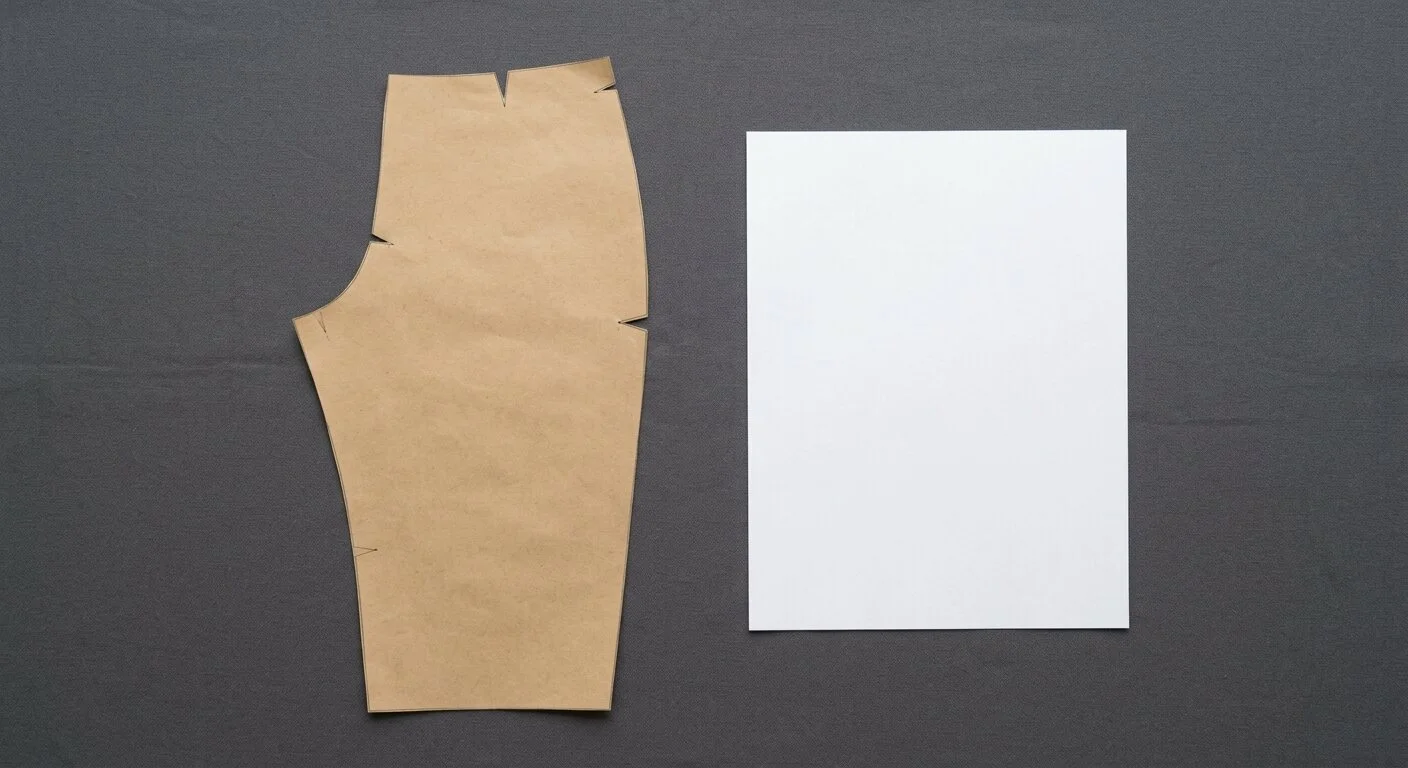
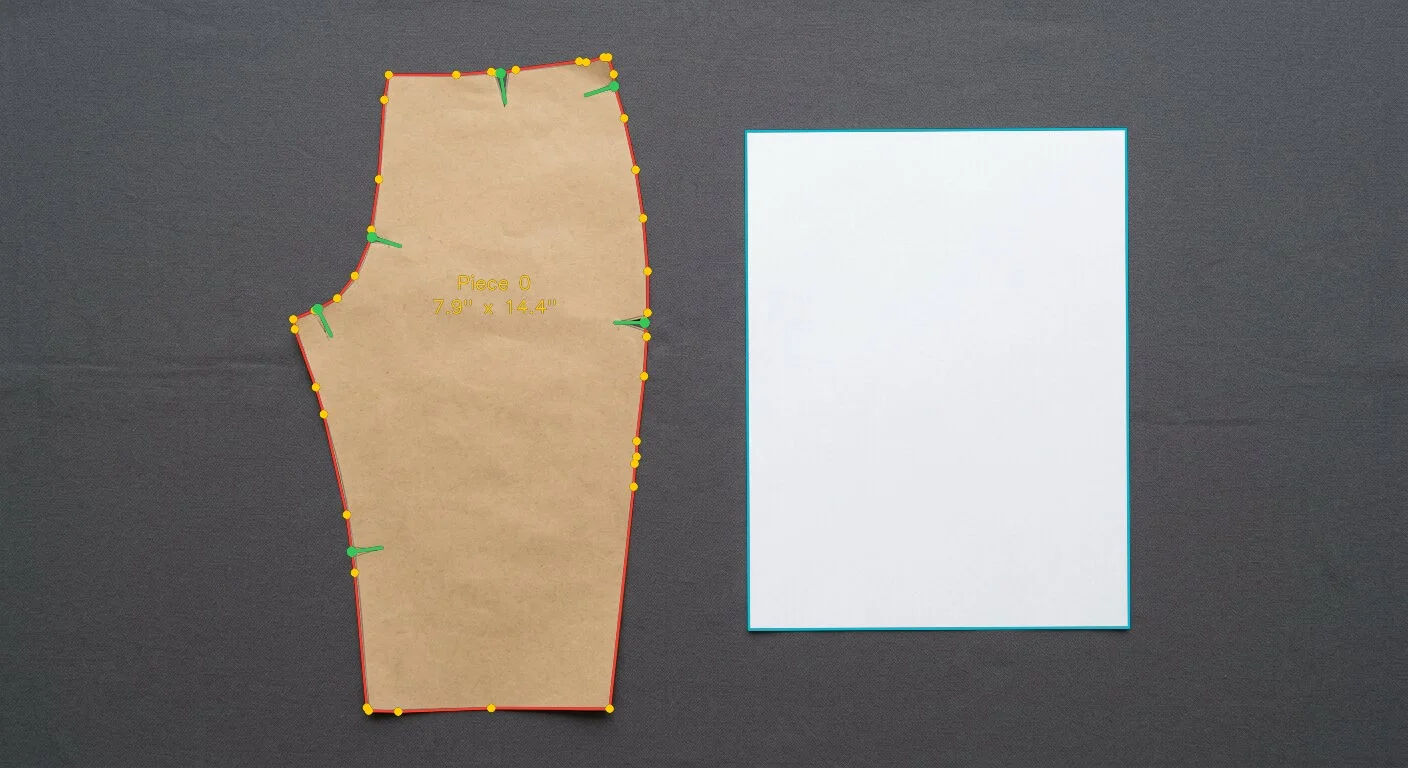
On paper, by never letting the original slide and never leaning the pencil away from the edge. On a photograph, by putting a known object in the frame. We use one sheet of US Letter paper, 8.5 by 11 inches, laid beside the piece: the sheet is measured in the picture and the true inches come from it, so the height the phone was held at stops mattering.
On our own control photograph the automatic trace put 95 per cent of its points within 1 pixel of the paper edge and found all six notches, six out of six. At the scale of that photograph one pixel is about 0.02 in, and the figure we quote for a piece shot straight down in ordinary room light is about 0.06 in. Measured 3 September 2026 on the sample photograph published on this site.
What happens to notches and the grain line?
They are copied as separate marks, not as part of the outline. On paper that means a short pencil stroke across the edge and a ruled arrow through the piece. In a file it matters more: a notch drawn as a bump in the cut line is a bump your cutter will follow.
Cut or drawn, both are real
A notch snipped into the paper is found by its shape. A notch someone drew across the edge with a pen is found by the ink line. Either way it comes back as a mark you can move, turn or delete.
Never leave it off
Cut a piece off grain and it twists on the body after the first wash. If the photograph has no grain line drawn on the piece, a default one is written into the DXF, because without a grain line industrial software refuses to import the notches at all.
Write on it before you forget
Piece name, size, how many to cut, which way is up. Two traced fronts that look alike at the table stop looking alike a week later.
Can you trace a sewing pattern with a phone instead?
Yes, and that is what this site does. You lay the piece flat with a sheet of Letter paper beside it, take one photograph from above, and the outline comes back as a DXF for pattern software, a Letter-tiled PDF to print and tape, and an HPGL PLT for a plotter or cutting table. Anything the trace got wrong you drag into place yourself in the browser, and correcting costs nothing.
What it does not replace: drafting a pattern from measurements, grading it to a size run, or judging whether a worn block is still the right shape. That is pattern making, and it stays with the person who knows the garment.
What does it cost to have a pattern traced for you?
A digitizing bureau charges per piece with a minimum per style. digitpatterns.com lists $7.50 per piece with a $50 minimum on every style, $75 to grade a piece to five sizes and $100 an hour for drafting from scratch, on their published price page, read 3 September 2026. Bureaus that quote by email, such as topnotchpattern.com and alisonhoenes.com, publish no prices at all.
Here the demo is free while it runs: every piece, all three files, unlimited corrections, no card and no minimum. Prices after the demo are not set yet, and when they are they will be published on the site.
Questions people ask about tracing
Is tracing a pattern better than cutting it out?+
For any pattern you might use again in another size, yes. Cutting the tissue commits it to one size and one set of alterations. Tracing keeps the original whole, and it is the only option for a borrowed pattern.
What paper is best for tracing patterns?+
Anything larger than the piece that you can see through: tracing paper, medical exam paper, dot-and-cross paper. For a photograph you need no special paper at all, only one ordinary sheet of Letter paper in the frame as the ruler.
How do I trace a pattern that is too dark to see through?+
Put it on a cutting mat and run a tracing wheel along the edge, then pencil over the dents. Photographing it works too, and it does not mind a dark piece: the outline is found by contrast, so a dark piece on a light surface reads as clearly as a light piece on a dark one.
Will a traced copy still fit the same?+
It fits the same if the size held. On paper the risk is the original sliding under your hand; on a photograph the risk is a tilted camera, which is why the sheet of paper is measured in the picture and the perspective is flattened against it.
Can I trace a pattern straight into my cutting software?+
That is what the DXF is for. Outline, notches, grain line and internal marks go on separate layers of an AAMA and ASTM file, which Gerber AccuMark, Optitex, Lectra Modaris, StyleCAD, Seamly2D and AutoCAD read directly.
How long does one piece take?+
About a minute from photograph to files, plus whatever time you spend correcting the outline. Hand tracing takes as long as the piece is large, and every notch and mark has to be copied over at the end. We have not measured hand tracing ourselves, so we do not quote a number for it.
Do you keep my pattern?+
Signed in, your pieces stay in your account so you can download them again. As a guest, the photograph and the result are deleted the moment your archive is downloaded, and anything you never download is removed within an hour.
Keep reading
Trace it once, keep it as a file.
Free while the demo runs. If the outline is not right, you fix it yourself.